
01Learn from power-user signals#
Overview surfaces patterns in captured work: parallel sessions, delegation, outputs, reusable skills, verification and more. Review the underlying evidence, pick a practice to improve and apply it in your next task. Signals describe the work; they do not rank people.
02Understand your activity#
See captured sessions, reported tokens, estimated spend, top models, connected devices and the kinds of work agents handle. Filters help you focus on a period, person, team, agent or tool within your access.
03Review the work behind a number#
Open a session to inspect its summary, retained messages, tool activity, usage and available signals. Follow a finding back to its evidence before deciding what to reuse.
04Read the evidence in context#
Only captured activity appears. Coverage varies by agent, and some findings are inferred. Missing data does not mean no activity; estimated spend is not your bill. Personal workspaces focus on your agents, while organization views follow your role.
05Turn session signals into a practical next step#
Use the Overview Assistant to investigate captured sessions in the selected scope. Its findings cite the session evidence behind them. Choose a finding you want to act on, such as repeatedly giving several agents the same background.
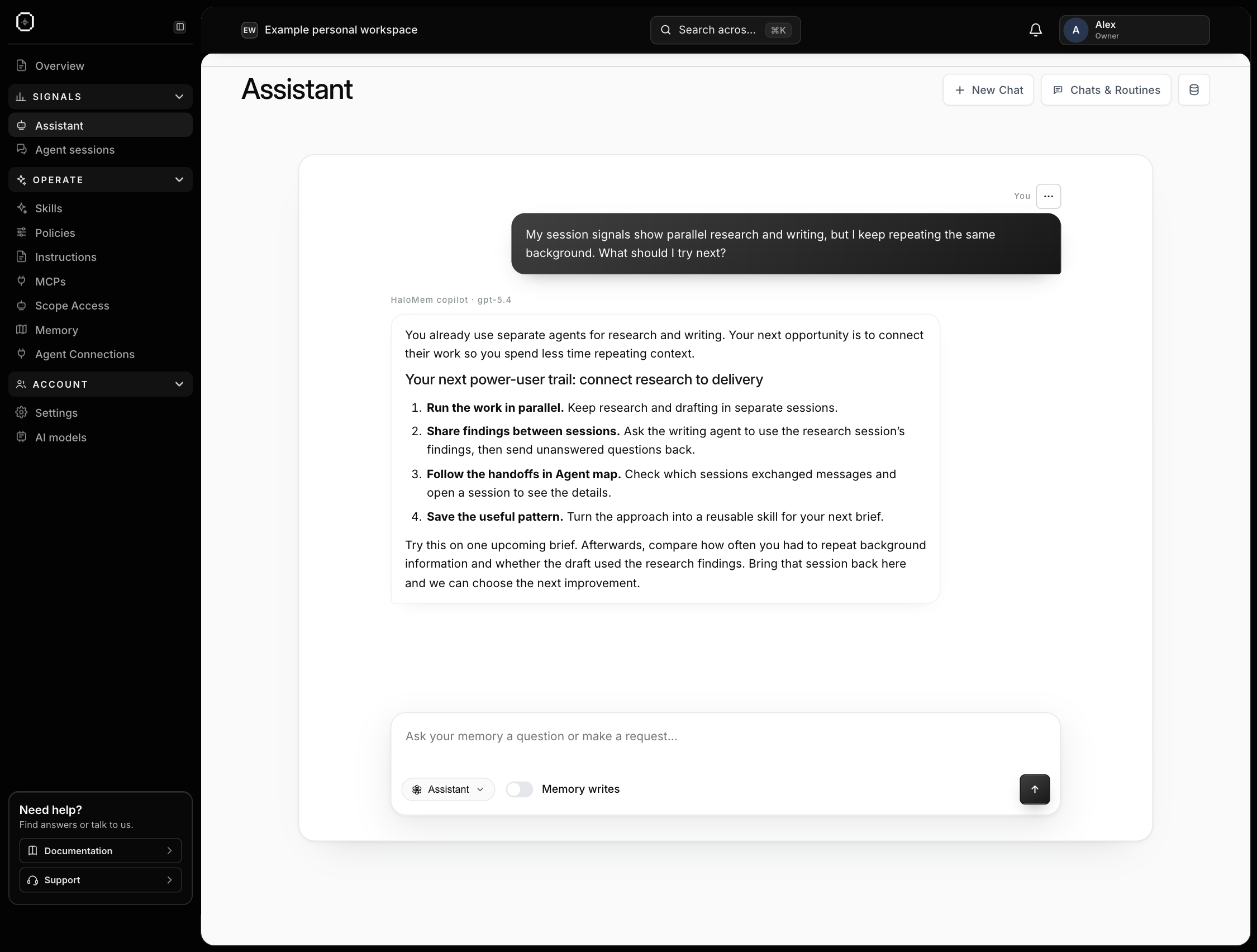
Bring that finding into Assistant and ask for a power-user trail: a short sequence of practices to try in your next task. The example below moves from parallel research and writing to shared context, visible handoffs and a reusable skill. Try the sequence, then return with the results to refine it.
The standalone Assistant uses the context you provide and accessible workspace memory. Overview analysis uses the selected session evidence. Model usage applies to generated analysis and replies.
06Turn a useful finding into your next workflow#
Practices looks for recurring workflows and lessons in captured sessions. Treat each result as a candidate: inspect the cited moments and decide whether the practice is useful beyond that one task.
From a finding, create a skill or policy draft, refine its instructions and submit it through the relevant review process. Saving a private draft does not publish it. A useful learning loop is: inspect evidence, identify a repeatable method, publish approved guidance and use it in a future session.
07Drill into an individual session#
A session brings together the participant, agent, models, usage, summary, retained messages and tool activity. Reported facts and inferred topics or outcomes are different kinds of evidence; inspect the underlying messages before treating an inference as a verified result.
Practice signals describe how work happened—such as parallel work, delegation, verification and reuse. Their coverage and method matter as much as the number. They help you find habits that increase what you can accomplish; they do not rank people.